7th October 2026 by Chris Johnstone
Why did the British Holistic Medical Association become the British Holistic Healthcare Association?
Chris Johnstone reflects on the journey from BHMA to BHHA, and why holistic healthcare needs to address not only health conditions, but also the conditions for health.
A conference that changed my life
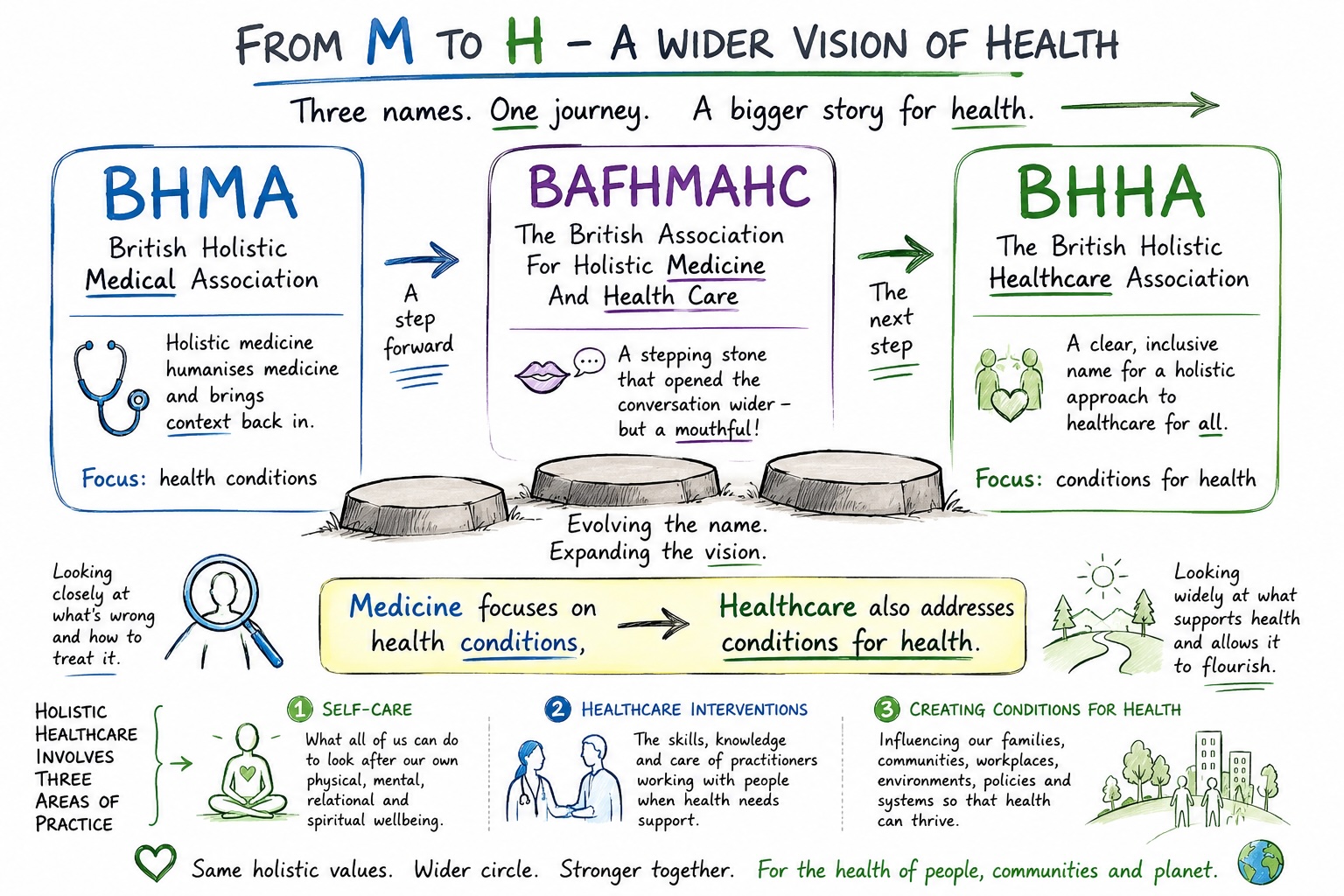
Over forty years ago, I went to a conference that changed my life. It was the 1983 launch event of the British Holistic Medical Association, (BHMA), which for more than four decades now has served as an inspiring hub for holistic practitioners. As a medical student back then, I joined other younger folk at the conference to form a BHMA student group. We later developed an education programme filling important gaps in my conventional medical training. My experience of that group set me and many of my peers on a path of deepening engagement in holistic thinking and practice. It left me with a grateful fondness for the letters B H M A. But a change of name earlier this year means the BHMA is no more. We are now the BHHA, the M for medical swapped with H for healthcare. What a difference one letter can make.
Putting the holistic into medicine
The original name also involved a transformative leap of one letter – contrasting with the more mainstream BMA (British Medical Association), the added H in BHMA placed the term Holistic at the heart of a movement to humanise medicine. There was a sense then, as now, that modern medicine, for all its marvels, had become overly mechanistic and reliant on medication. The BHMA became registered as a charity with the goal to “explore, educate and inform doctors, medical students, other healthcare professions and members of the general public in the principles and practice of compassionate holistic medicine and health care.”
In a keynote paper based on his 1983 conference talk, the BHMA’s founding chair Patrick Pietroni mapped out seven principles guiding holistic medical practice (1). These are:
Multidimensionality: Seeing people as multidimensional beings with body, mind and spirit inextricably linked, these forming a whole that is more than the sum of its parts.
Interconnectedness: seeing people as deeply rooted in the contexts of their family, community, and environment, bringing a need to take these dimensions into account.
Disease as Imbalance: recognising that illness can be a signal of internal imbalance or external stress and it can play a role in alerting us to these.
Innate Self-Healing: everyone possesses a natural, inherent capacity for self-healing and regaining balance.
The Practitioner’s role: primarily as a supporter of each person’s self-healing, rather than a fixer of a broken body machine.
Education is intervention: helping people strengthen their self-healing capacity through training and education.
Physician Heal Thyself: in order to treat others effectively, healers need to give attention to developing their own self-awareness and inner balance.
From treating illness to caring for health
Informed by these principles, it was clear from the beginning that the BHMA was committed to a wider view of caring for health than the mainstream medical focus on diagnosis of conditions and their treatment. The last principle, ‘physician heal thyself’, became the motto of the organisation and brought into the foreground the issue of practitioner wellbeing. But the combination of this motto with the M for Medical in BHMA created, at least for some people, an impression that this was a doctor-centric group. That clashed with the desire to develop a broader more inclusive movement that welcomed not just a wide range of holistically orientated practitioners but also interested members of the public. There was another tension around the M word too.
Health conditions – and the conditions for health
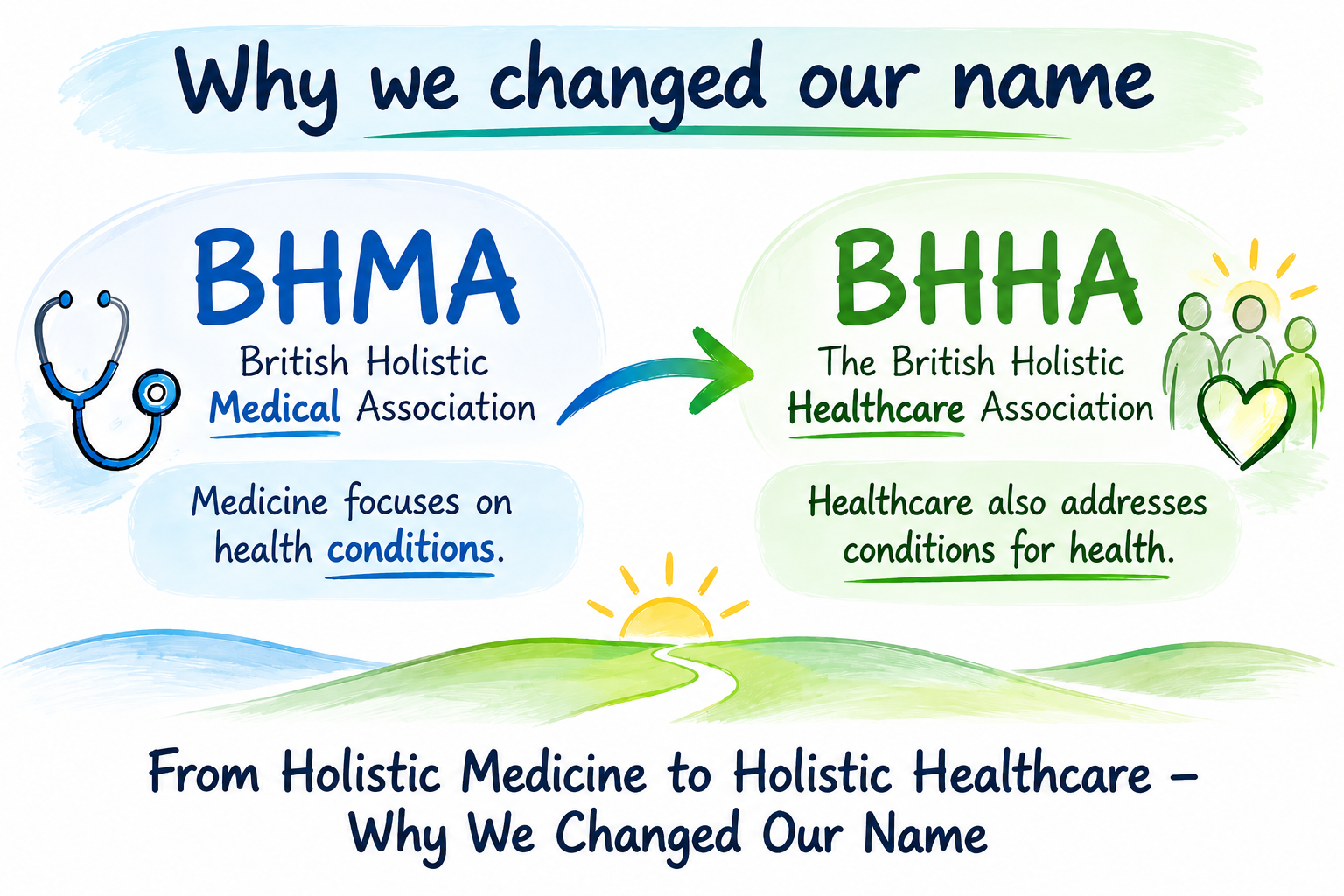
The trigger point for seeking medical attention, even when its holistic, tends to be when something has gone wrong. But caring for health also asks us to look upstream, at what helps health develop, protects it and allows it to flourish. Medicine focuses on health conditions; healthcare also addresses conditions for health. Recognising that medicine was just one part of a larger story of what helps health happen led the organisation to change its name. It became ‘The British Association for Holistic Medicine and Health Care’.
This name didn’t catch on. It didn’t roll off the tongue easily and people in the organisation often found themselves continuing to use the old name. A bigger issue in the background was the disturbing decline in healthy life expectancy in the UK (2). Healthy life expectancy refers to the average number of years a person can expect to live in ‘good’ or ‘very good’ health. Between 2012-14 and 2022-2024, this measure fell by around two years, the decline beginning even before COVID. There was a sense that to really have an impact on health, we needed to shift our gravitational centre from holistic medicine to holistic healthcare. So in early 2026, we changed our name a second time, to become the British Holistic Healthcare Association, the BHHA.
Three dimensions of holistic healthcare
This wider view of holistic healthcare can be seen as involving three overlapping areas of practice. These are:
Self-care
What all of us can do to care for and support our own health.
Healthcare interventions
The skills, knowledge and care practitioners bring when someone’s health needs support.
Creating conditions for health
What we can influence collectively through our communities, workplaces, environments, policies and systems so that health has a better chance to flourish.
From BHMA to BHHA
A holistic approach needs to ask not only, “How can we treat illness well?” but also, “How can we care for health – our own, each other’s and the conditions upon which our collective health depends?” This is why we’ve swung from M to H. We’re pleased to be the BHHA, the British Holistic Healthcare Association, and we invite you to join us.
References
- Pietroni, P. C. (1984). Holistic medicine – new map, old territory. British Journal of Holistic Medicine 1: 3-13.
- See https://www.health.org.uk/reports-and-analysis/analysis/healthy-life-expectancy-trends-in-the-uk-a-watershed-moment
Summary image.